
Part 3 of 3: How compounding context and system of action work together
The short version
- Compounding context and a system of action are separate, but together they form a flywheel, and the human steps back a little more each cycle.
- Deterministic, rules-based logic still matters. It is how a probabilistic AI product earns trust.
- These are gradients, not gates. Early-stage companies don't need to be there yet. They need a clear path.
Why one without the other stalls
Plenty of products learn a great deal about their customers and never get permission to do anything with it. Others take actions but learn nothing from them. Either way the flywheel never starts.
Legacy software earned the right to act by being predictable. AI has to earn it twice.
Payroll and payment systems do exactly what they are told, and you can check why. AI reasoning is probabilistic, so it earns trust two ways: by pairing that reasoning with deterministic logic and clear guardrails, so the parts that must be predictable stay predictable, and by building a track record of graded outcomes. That track record is compounding context. Acting generates more graded outcomes, which deepen the context, which earns more latitude to act.
The flywheel in practice: ketteQ
Vocap portfolio company ketteQ, a supply chain planning platform, shows the loop at work. It ships with generalized planning best practices, then learns and improves inside each customer's environment. Its Quintus orchestration solution breaks down complex objectives into tasks and coordinates the agent team, while its proprietary PolymatiQ solver runs thousands of simultaneous scenarios and resolves supply chain issues in real-time. Quintus learns from every exception and never forgets, while the PolymatiQ solver keeps the AI from just ‘guessing’ on complex supply questions, and reliably generates the same output given the same set of input. As this is put in place, human planners transition from being bogged down in handling exceptions, to overseeing the actions Quintus recommends and executes on their behalf.
The agent team pairs with a deterministic solver and guardrails, which earn the right to act. The graded outcomes compound the context.
The best practices come in the box. The durable part is everything each customer's overrides and results teach the product after that.
How fast can a company climb?
Bessemer's vertical AI playbook describes the path: start in tertiary workflows like documentation and research, move to adjacent features like underwriting analysis, and earn your way into the core.
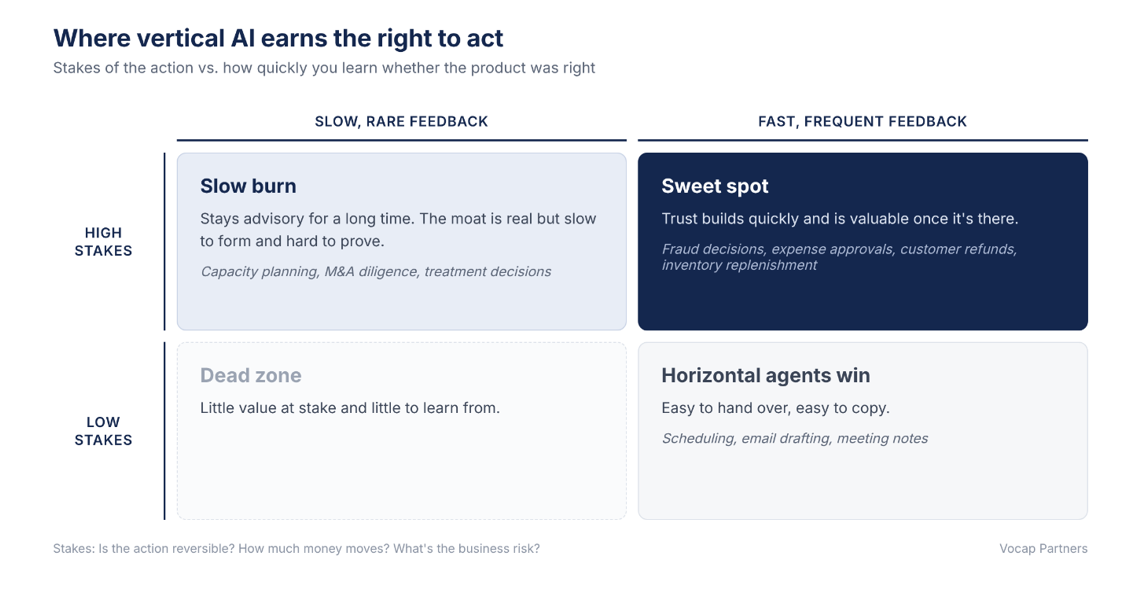
Speed depends on stakes and feedback. When a doing tool gets something wrong, can it be undone? How much money moves? High stakes make trust more valuable and slower to earn. The other variable is how quickly and how often you learn whether the product was right.
Put those two variables on a grid and the picture is clear.
A gradient, not a gate
The best vertical AI companies end up in the sweet spot: consequential actions, taken often, graded quickly. Few start there, and they shouldn't have to.
A product can begin as an information tool in a tertiary workflow, with a person checking every output, and still be a great investment. What matters early is that the founder can see the path: which outcomes the product will learn to grade, which decisions customers will hand over first, and what proof earns the next step. We back the climb, not only the current position. And as we argued in our Kelly Johnson piece, the company that embeds earliest starts compounding first.
What we ask founders
- What does your product know about a customer on day 400 that it didn't on day 1, and how do you know it's right? Does that memory live only in your system?
- Is your product an information tool or an action tool? If it acts, what does it cost your customer when it gets an action wrong?
- What share of the outcome does your product execute today with no human touching it, and what is your path to increasing it?
A company with good answers to all three is building something a model release cannot take away.
The landscape moves every quarter and we will keep updating our views with it. What hasn't changed since Part II:
The intelligence layer is commoditizing. The execution layer is the prize.
Further reading
From Vocap: Forget the SaaSpocalypse. Here's How Vertical AI Actually Wins; Part II: Building the Moat; What Vertical AI Founders Can Learn From Kelly Johnson (organization and speed as part of the moat).
Elsewhere: Bessemer Venture Partners, Building Vertical AI and Roadmap: AI systems of action; Foundation Capital, AI's trillion-dollar opportunity: Context graphs.